
Therapy provides a powerful space for exploring the roots of anxiety, reframing thought patterns, and building emotional resilience—but the real work often continues outside the therapy room. Between sessions, anxiety can flare up during daily stressors, unexpected events, or moments of quiet self-reflection. That’s why at Dalliance Therapy Center in Parker, CO, we empower our clients with tools they can use every day to manage symptoms and reinforce progress. To see how these techniques complement other options like therapy or medication, read our guide on therapy, breathwork, or medication for anxiety.
To see how these techniques complement other options like therapy or medication, read our guide on therapy, breathwork, or medication for anxiety.
Anxiety doesn’t follow a schedule. It may surface at work, at night, or while running errands. Having practical, reliable techniques to use between appointments not only supports your healing—it gives you a sense of control over your experience. This article highlights several accessible strategies you can begin incorporating into your daily life today.
Why Daily Tools Matter in Anxiety Treatment
One of the biggest challenges with anxiety is that it can feel unpredictable and overwhelming. It creates both physical and mental distress—racing thoughts, chest tightness, restlessness, difficulty concentrating—and these symptoms often intensify without warning. While therapy offers a long-term framework for managing anxiety, daily tools act as your frontline defense.
At Dalliance, we approach anxiety care holistically. This means we don’t just explore what’s causing the anxiety—we also help you develop immediate, body-and-mind strategies to stabilize your nervous system, regulate your emotions, and stay grounded between sessions.
Symptoms You Can Manage in Real Time
Before diving into the tools themselves, it’s important to understand the types of symptoms you can influence in-the-moment:
- Physical symptoms like rapid heartbeat, muscle tension, shortness of breath, and stomach discomfort
- Cognitive symptoms such as looping or intrusive thoughts, worst-case scenario thinking, and mental fog
- Emotional responses like irritability, fear, or sudden overwhelm
By learning to recognize early signs of anxiety, you can implement strategies before symptoms escalate into panic or shutdown.
Daily Tools for Managing Anxiety Outside the Therapy Room
Below are simple yet effective tools you can begin using today to regain focus, reduce physical tension, and feel more emotionally anchored:
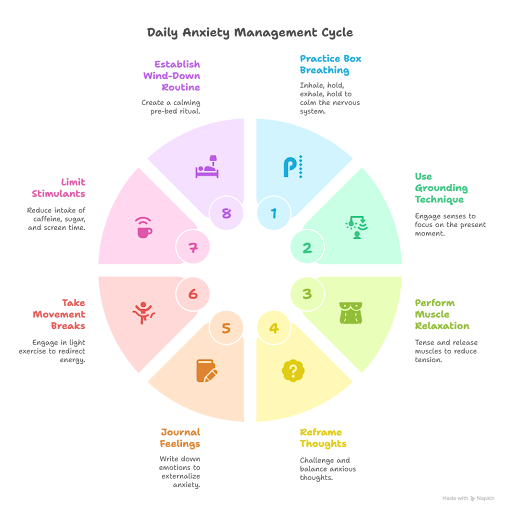
- Box Breathing (4-4-4-4): Inhale for 4 counts, hold for 4, exhale for 4, hold for 4. Repeat for 2–5 minutes to calm your nervous system.
- 5-4-3-2-1 Grounding Technique: Identify 5 things you can see, 4 you can feel, 3 you can hear, 2 you can smell, and 1 you can taste. This pulls your attention into the present.
- Progressive Muscle Relaxation: Start at your toes and work upward, tensing and releasing each muscle group to discharge built-up tension.
- Thought Reframing: Catch anxious thoughts and ask, “Is this true? What else could be possible?” Replacing catastrophic thinking with balanced reasoning helps shift your mindset.
- Journaling Bursts: Take 5–10 minutes to write down what you’re feeling and thinking. This externalizes anxiety and gives it structure.
- Movement Breaks: Short walks, stretching, or light yoga can reduce physical agitation and redirect anxious energy.
- Limit Stimulants: Monitor your intake of caffeine, sugar, and screen time—these often amplify symptoms of anxiety.
- Create a Wind-Down Routine: Establishing a pre-bed ritual (dim lights, calming music, screen-free time) signals safety to your nervous system.
These techniques are most effective when practiced regularly, even during calm periods. Repetition helps retrain your body and brain to respond more adaptively to stress.
How Dalliance Integrates These Tools Into Treatment
At Dalliance Therapy Center, we don’t just teach these techniques—we customize them. Your therapist will help you identify the strategies that best align with your lifestyle, symptom patterns, and energy levels. We introduce these tools in-session and build a plan for how to implement them at work, home, or school.
Our goal is not just to reduce anxiety—it’s to help you build emotional independence. With time, many clients find they’re able to interrupt anxiety spirals before they intensify, using tools that are easy to remember and apply in real time.
You Have More Power Than You Think
Anxiety can be persistent, but it doesn’t have to be paralyzing. With the right tools and therapeutic support, it’s possible to build a daily rhythm that fosters calm, resilience, and clarity. You don’t need to wait for your next session to feel relief—change starts now, one breath, one choice at a time.
If you’re ready to take control of your anxiety and build a toolkit that works in real life, Dalliance Therapy Center is here to guide you every step of the way.